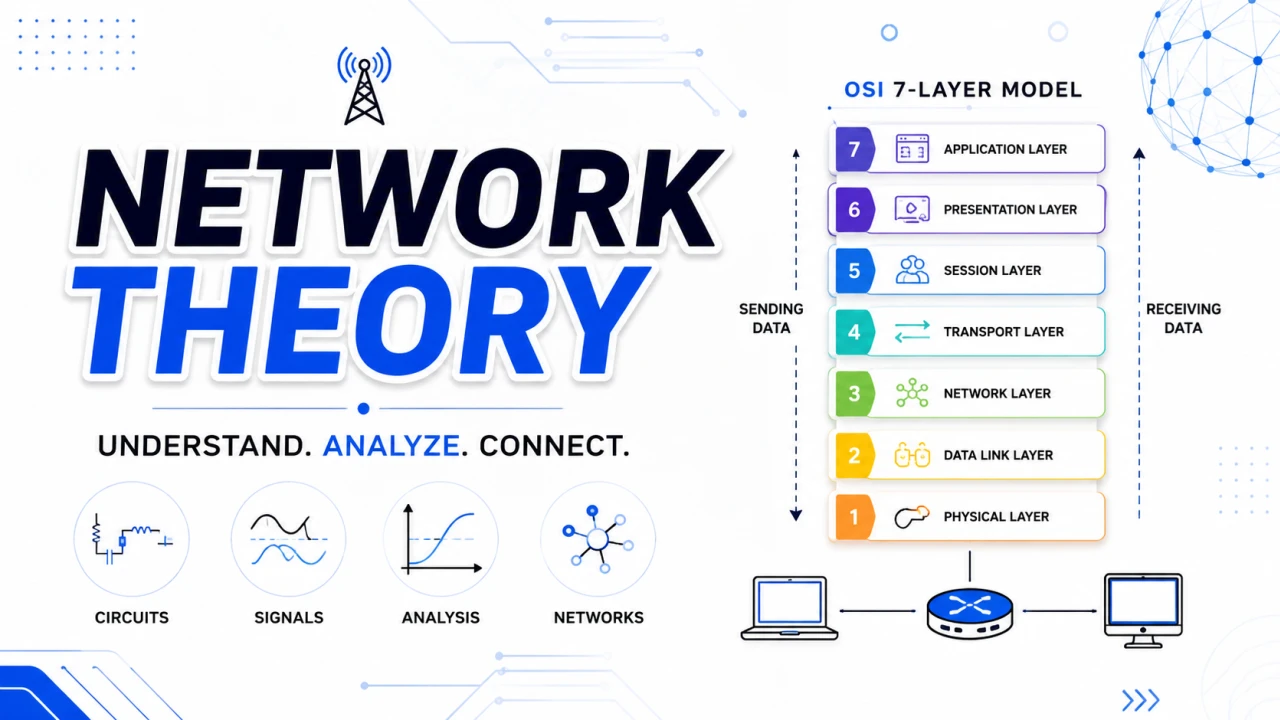
This Network Theory course is designed as an intermediate-level deep dive into the architecture and operational protocols of modern computer networks. It follows a layered pedagogical approach, mirroring the standard networking stack to help you move from the physical mechanics of data flow to the complex services that power the internet.
Course outline 1. Data Communication Components
Introduction to Data Communication & Data Flow Network Topologies & Categories The OSI Reference Model Transmission Media Wired LANs & Connecting Devices Wireless LANs (WLAN) & Virtual LANs (VLAN) Bandwidth Utilization – Multiplexing Spread Spectrum Concepts2. Data Link Layer and Medium Access Sub Layer
Fundamentals Block Coding & Hamming Distance Cyclic Redundancy Check (CRC) Flow and Error Control – Stop-and-Wait Protocols Sliding Window Protocols (Go-Back-N & Selective Repeat ARQ) Random Access Protocols (ALOHA & CSMA) CSMA/CD (Collision Detection) CSMA/CA Collision Avoidance and Medium Access Control in Wireless Networks3. Network Layer
Introduction to the Network Layer and Switching Logical Addressing with IPv4 IPv4 Addressing Techniques and Usage Logical Addressing with IPv6 Address Mapping: ARP and RARP Host Configuration Protocols: BOOTP and DHCP Delivery and Forwarding Unicast Routing Protocols4. Module 4: Transport Layer
Process-to-Process Communication User Datagram Protocol (UDP) Transmission Control Protocol (TCP) SCTP and Congestion Control Quality of Service (QoS) and Traffic Shaping Techniques5. Application Layer
Introduction to Application Layer Services and Protocols Domain Name System (DNS) and Dynamic DNS (DDNS) TELNET and Remote Access Services Electronic Mail Services and Protocols File Transfer Protocol (FTP) World Wide Web (WWW) and Hypertext Transfer Protocol (HTTP) Simple Network Management Protocol (SNMP) Bluetooth as an Application-Oriented Wireless Service Platform Firewalls and Network Access Control Basic Concepts of CryptographyStart learning