Retrieval-Augmented Generation (RAG) — From Fundamentals to Production-Ready Agentic RAG Systems

Retrieval-Augmented Generation (RAG) — From Fundamentals to Production-Ready Agentic RAG Systems
advanced40+ hours54 sections

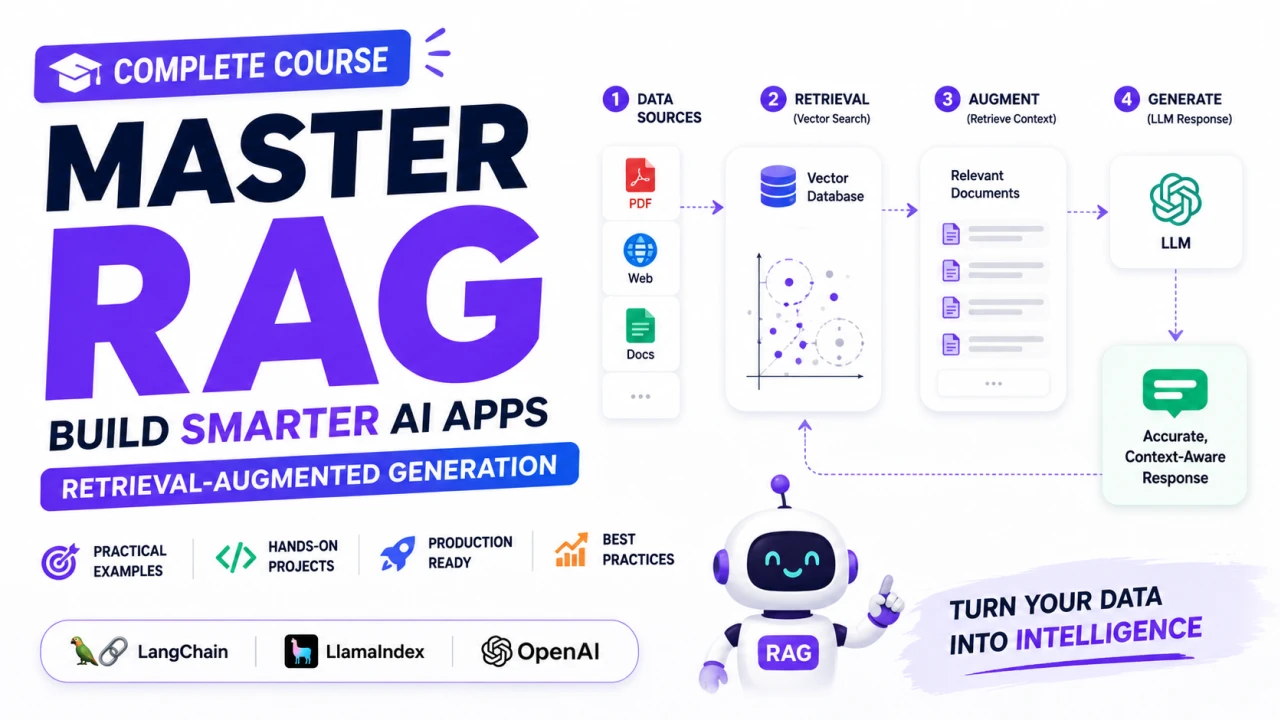
A comprehensive, end-to-end course through Retrieval-Augmented Generation — beginning with core concepts and document processing, advancing through embeddings, vector stores, and retrieval techniques, and culminating in agentic RAG systems built with LangGraph and a deployable capstone project.

What you'll learn

  • Understand the RAG architecture and when to use it vs fine-tuning vs prompt engineering
  • Master document processing, chunking strategies, and metadata management
  • Select and implement appropriate embedding models for different use cases
  • Deploy and operate vector stores including Chroma, FAISS, Qdrant, and Pinecone
  • Implement basic and advanced retrieval techniques including hybrid search, MMR, and re-ranking

  • Build advanced RAG patterns: RAG Fusion, HyDE, Corrective RAG, Self-RAG, and Graph RAG
  • Design and implement agentic RAG systems using LangGraph with multi-step reasoning
  • Evaluate RAG pipelines using RAGAS with comprehensive metrics
  • Deploy a production-ready RAG system with monitoring, caching, and optimization

Prerequisites

  • Python fundamentals (functions, classes, async/await)
  • GenAI fundamentals (LLM basics, tokens, prompting)
  • LangChain basics (Chains, LCEL, tool usage)
  • LangGraph basics (StateGraph, nodes, edges, conditional routing)

Course outline

1. RAG Fundamentals and Architecture

2. Document Processing and Chunking

3. Embeddings and Vector Representations

4. Vector Stores

5. Basic Retrieval Techniques

6. Advanced Retrieval Techniques

7. Advanced RAG Patterns

8. Agentic RAG with LangGraph

9. Evaluating RAG with RAGAS

10. Capstone Project with Deployment

Chat with Kiro